Pol's Business Talks / field note
Net Income Formula

By Arthur Sloan
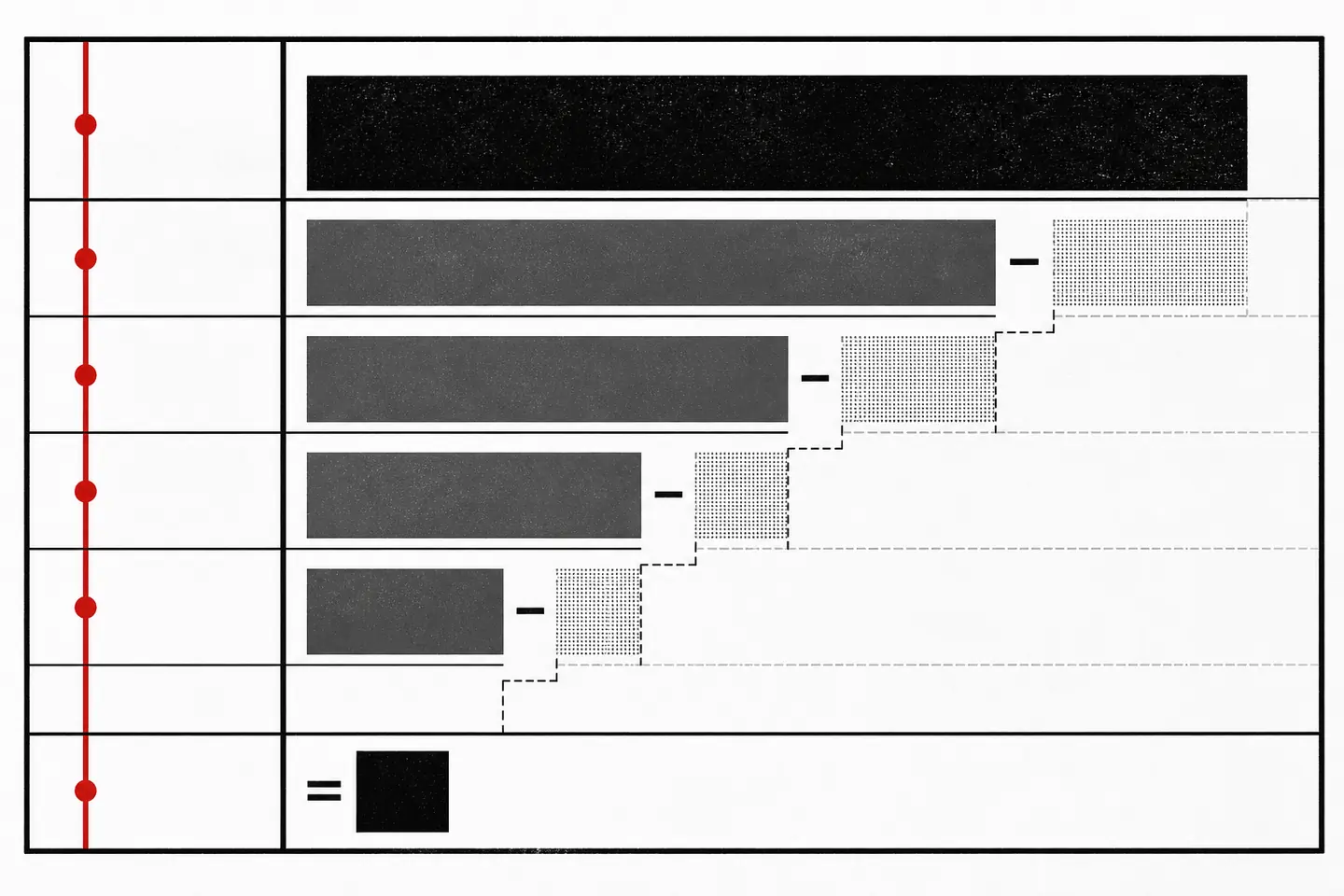
Net income is the profit or loss left after all recognised expenses have been deducted from revenue for a reporting period. It is often called the bottom line because it usually appears near the end of the income statement. A clear net income calculation helps readers distinguish final earnings from revenue, gross profit and operating profit.
The basic formula is simple, but a reliable result depends on complete records and consistent classification. Revenue and expenses must cover the same period, each cost must be recorded once, and non-operating items and tax must not be overlooked.
The net income formula
Net income = total revenue − total expenses
Total expenses include the direct cost of goods or services, operating expenses, interest, tax and recognised losses. Recognised gains and other income increase the result. If the final amount is positive, the business reports net income or net profit. If it is negative, the business reports a net loss.
A more detailed version shows the order in which an income statement is usually read:
Net income = revenue − cost of sales − operating expenses + other income − other expenses − interest − income tax
This expanded formula is useful because it distinguishes performance in the main business activity from financing, tax and unusual items. Net income calculation and reporting also affect retained earnings, although dividends and other equity movements must be considered separately.
What belongs in the calculation
Revenue
Revenue is the income earned from supplying goods or services before expenses are deducted. Use revenue recognised for the period, not simply cash received. Under accrual accounting, an invoiced sale may be recognised before the customer pays. Returns, allowances and discounts reduce gross sales when the accounting records require them to be reported net.
Keep business revenue separate from money that is not income. A loan increases cash and creates a liability, but it does not increase net income. An owner’s capital contribution also affects cash and equity rather than revenue.
Direct costs and gross profit
Businesses that sell goods normally deduct cost of goods sold from revenue to calculate gross profit. Cost of goods sold can include the purchase or production cost of inventory sold during the period. Unsold inventory remains an asset until it is sold or otherwise written down.
A service business may use labels such as cost of services or direct project costs. These can include subcontractor fees or labour directly attributable to client work. Classification policies vary, so compare periods only after confirming that similar costs have been treated consistently.
Gross profit = revenue − direct costs
Operating expenses
Operating expenses are the costs of running the business that are not included in direct costs. Common categories include administrative payroll, premises, utilities, insurance, professional fees, marketing, office costs and depreciation. Subtracting them from gross profit gives operating income.
Operating income = gross profit − operating expenses
Capital spending needs different treatment. Buying equipment does not usually make the full purchase price an immediate income-statement expense. The asset is recorded on the balance sheet, and depreciation allocates its cost over its useful life according to the applicable accounting policy.
Non-operating items, interest and tax
After operating income, include gains and losses outside ordinary operations. Examples include interest income, interest expense, a gain or loss on selling an asset, an impairment charge or a foreign-exchange movement. Their placement matters because a one-off gain can lift net income even when normal operations have weakened.
Interest is the cost of borrowing, but repayment of loan principal is not an expense. Principal reduces cash and the loan liability. Income tax expense is then deducted from pre-tax income. Tax expense may differ from tax paid in cash because accounting and tax rules can recognise items in different periods.
A worked example
Suppose a small service business reports 240,000 of revenue for a year and 60,000 of direct project costs, in whatever currency it reports. Its gross profit is 180,000. It then records 92,000 of payroll and premises costs, 14,000 of other operating expenses and 6,000 of depreciation.
The calculation proceeds in stages:
- Revenue of 240,000 minus direct costs of 60,000 gives gross profit of 180,000.
- Gross profit of 180,000 minus operating expenses of 112,000 gives operating income of 68,000.
- Operating income of 68,000 minus 5,000 of interest gives pre-tax income of 63,000.
- Pre-tax income of 63,000 minus 12,000 of income tax expense gives net income of 51,000.
The same result can be checked in one line:
240,000 − 60,000 − 92,000 − 14,000 − 6,000 − 5,000 − 12,000 = 51,000
This is a hypothetical calculation, not a benchmark. A real business may use different line items or labels, but every recognised amount should still flow through the statement once.
How to find net income on a statement
Read the income statement from top to bottom. Revenue appears first, followed by direct costs and gross profit where those subtotals are used. Operating expenses lead to operating income. Non-operating gains and losses, finance costs and tax then lead to net income. This sequence follows the usual income statement definition and structure.
The final line may be labelled net income, net earnings, profit for the period or net loss. Do not stop at gross profit, earnings before interest and tax, or operating income. Each of those measures excludes costs that the net income formula includes.
Some statements distinguish profit attributable to owners from profit assigned to non-controlling interests. They may also show income available to ordinary shareholders after preference dividends. When calculating earnings per share or comparing published figures, check which final earnings measure is being used.
Net income is not cash flow
Net income measures accounting performance, while cash flow measures movements of cash. The two figures differ because revenue can be recognised before collection, expenses can be recorded before payment, and non-cash charges such as depreciation reduce profit without using cash in that period.
A profitable business can still face a cash shortage if customers pay slowly, inventory absorbs funds or debt principal falls due. Conversely, borrowing can increase cash even though it does not create profit. Review the cash-flow statement and balance sheet alongside net income when assessing liquidity or the ability to meet obligations.
Using net income carefully
Net income becomes more informative when compared with revenue and with equivalent periods. Net profit margin expresses the relationship:
Net profit margin = net income ÷ revenue × 100
In the worked example, 51,000 divided by 240,000 gives a net margin of 21.25 per cent. The figure is arithmetic derived from the example, not a claim about a typical business. Compare margins only across similar activities and accounting periods because cost structures differ.
When net income changes, trace the movement through the statement. Revenue may rise while profit falls because direct costs or overheads grew faster. Net income may rise despite weaker operations because of an asset-sale gain. Separate recurring trading performance from material unusual items, but do not remove ordinary costs merely to produce a more favourable adjusted figure.
Common calculation errors
- Confusing revenue with profit. Revenue is the starting amount, not the earnings left after costs.
- Using gross profit as net income. Gross profit excludes operating expenses, interest, tax and other recognised items.
- Mixing reporting periods. Annual revenue cannot be combined with one month of expenses.
- Counting a cost twice. Paying a bill previously recorded in accounts payable reduces cash and the liability; it does not create a second expense.
- Expensing loan principal. Only the interest element affects net income.
- Treating cash receipts as revenue automatically. Customer deposits, loans and capital contributions may increase cash without being earned revenue.
- Ignoring non-cash expenses. Depreciation and impairment can reduce net income even when no cash leaves during the period.
A practical checking process
- Choose the reporting period and use the same accounting basis throughout.
- Reconcile revenue to sales records, returns, allowances and other supporting documents.
- Separate direct costs from operating expenses according to the established accounting policy.
- Check that accruals, prepayments, depreciation and inventory movements belong to the period.
- Add other recognised income and deduct losses, interest and tax.
- Recalculate each subtotal and confirm that every transaction appears once.
- Compare the result with prior periods, cash flow and the balance sheet, investigating material differences.